Monday, 25 March 2013

Figure: Movement


This drawing effectively shows that the person is moving due to the change of the pose. The curve of the figures spine changes as the arms push back the stick, as that happens the head angles down which also shows that this figure is moving. The balance of the figure is helped by the stick and the positioning of the hands on it. The positioning and proportion of the feet helps give the body of the figure balance because they are not  too large making it look unrealistic or too far making it impossible for the figure to stand.The figure starts in and open form because of the arm being stretched out however as the figure moves the it starts to become more of a closed form due mostly to the arms coming on to the body. This is a dynamic pose due to the movement of the stick which at the start the eye can see the stick will be going back as the figure moves forward.

The proportion and relative scale in this drawing is good vertically because all of the figures limbs have been correctly measured by the head. however there is a problem with the horizontal measurement as the arm on the right which is reaching down is too far down and should be closer to the torso. The angles in this drawing are vital because they show the movement between each drawing. The angles on the arms are the most important because the stick is the thing that is always in a different position  in each drawing, without the angles the middle and the left drawings will not be accurate with the drawing on the right.  The axis of the figure was defined by the spine which also shows how the shoulder are with the stretched arms. This  was drawn externally which could explain the horizontal proportion. Instead of drawing the contour of the figure an internal approach  which shows the direction of the ribs and pelvis would have  helped to capture the pose in each drawing which would show how the figure is moving.

Figure: Balance and Weight


The figures pose is more static because the curve that the spine and the stretched arms gives the impression that the figure is resting on a box and there is no sign of possible movement. The black & white shading is supposed to make the figure look 3 dementional while using the contrasting colours to show the how the light hits the figure. However the black shading on the legs do not have the same effect it tricks the eye.The proportion of the arms and the legs are correct due to the measurements of head. The weight of the figure is on the legs and along the back and the figures arms are hanging  and as the figure is standing up. The gesture is ok because the eye is able to tell that the hands are resting on something and there are no limbs in any painful unnatural position.

The main axis of the body is clear because of the quick stroke used for the spine which also has the indication of the shoulders. The external approach to drawing this figure was used so the lines are supposed to be long and flowing as they are the contour of the figure. The drawing could have been better if it was done with the internal approach as that would show the skeleton and the direction of the spine and limbs, which will also be used to indicate how the pelvis and the ribs which should be good enough to capture the pose. The balance & weight in the drawing is good because every muscle in the figure has been drawn so that the figure looks like it is not going to fall down. The gesture in this drawing is ok because the angle of the back shows that the figure is bending down while the shape of the hands and the bend in the knees all show that the figure is leaning on a object. This makes the drawing look more alive and less boring.


Figure: Anatomy Refresher


The anatomy is good as the cranium is shaped right and the foreshortening on the clavicle is ok which makes the angle of the figure ok. The Humerus is ok and in proportion however the Bicep might be a little small. The Femur, Tibia and the Fibula are in proportion and the muscles surrounding them are not  to large to make them unreal.This is a static pose as the figure is lying down on the mattress and the figure can be in this pose for a long time. The gesture in this drawing is important because without the leg being bent up and held up from the foot. If that knee was not higher then the rest of the figure the drawing would loose life and it would be a lot less interesting for the eye.

There is a real sense of depth for the legs mostly because of the shading on the back of the leg and the on the drapery underneath the knee which really adds to the drawing. The ankle also gives depth to the foot which brings out the foot and makes the figure more realistic.The relative scale of the drawing is strong as the everything looks to be measured to the size of the cranium vertically and horizontally meaning that the anatomy of the figure is correct.

Figure: Foreshorterning

The drawing has been planned well on the paper as the image fits with the angle that the skeleton was positioned. The foreshortening in the image is ok because of the faint blocks used to construct the bones however the back of the cranium does not look right because it looks like the jaw is sticking too far.The proportion on the Ribs looks off because it feels like it is not connected to the pelvis and it is pushed out. The form of the bones looks ok as the eye is able to see the curves that are on the skeleton however some bones like the Fibula could be more visible in the image.If some impressionistic techniques were used the on the skeleton the complexity of the ribs could look like it is connected to the Sternum without making that part of the image look a mess which would distract the eye from the rest of the drawing.

The overall proportion & relative scale of the body to the cranium is ok as ribs are vertically in proportion and is horizontally in proportion. The pelvis and the legs are all measured to the scale of the cranium  the same goes to for the arm. There could be a better sense of depth on the ribs just so that it does not look like there is a lot of lines and give the impression that there are bones. There could also be a better sense of depth on the Ulna, Radius, Tibia and Fibula as these bones are close together the on the legs and the arms and in the drawing they merge almost so they could have a little bit more space between  them and they could also have some shading to show that they are separate from each other.  

Saturday, 16 February 2013

Still Life: Composition


The shading on the objects makes them more three dimensional and it also makes the folds so the drapery connects the image with the lines made. The line which shows the balance of light and darkness in this image goes from top right to bottom left. The line that allows the eye to follow the entire image starts at the top of the  jug which is the focal point as it is in the rule of thirds and then it follows the line down to the to the vase  then the line can be followed to the bottle.The objects in this image are well proportioned as it is clear that the jug is further from the eye line because of the elliptical at the top. The folds of the drapery add a level of depth to the composition because of the direction that the shading goes.

The arrangement of the objects is good for the composition because the three objects are close together which means that there are no orphaned objects and the are no kissing edges which would confuse the eye because the two lines connect. This is also a good example because all of the objects overlap with one the jug being in the foreground, the carafe in the mid ground of the bottle in the background. This  makes it easier for the eye to tell which object is closer and which is the focal point of the image.

Still Life: Light & Shade


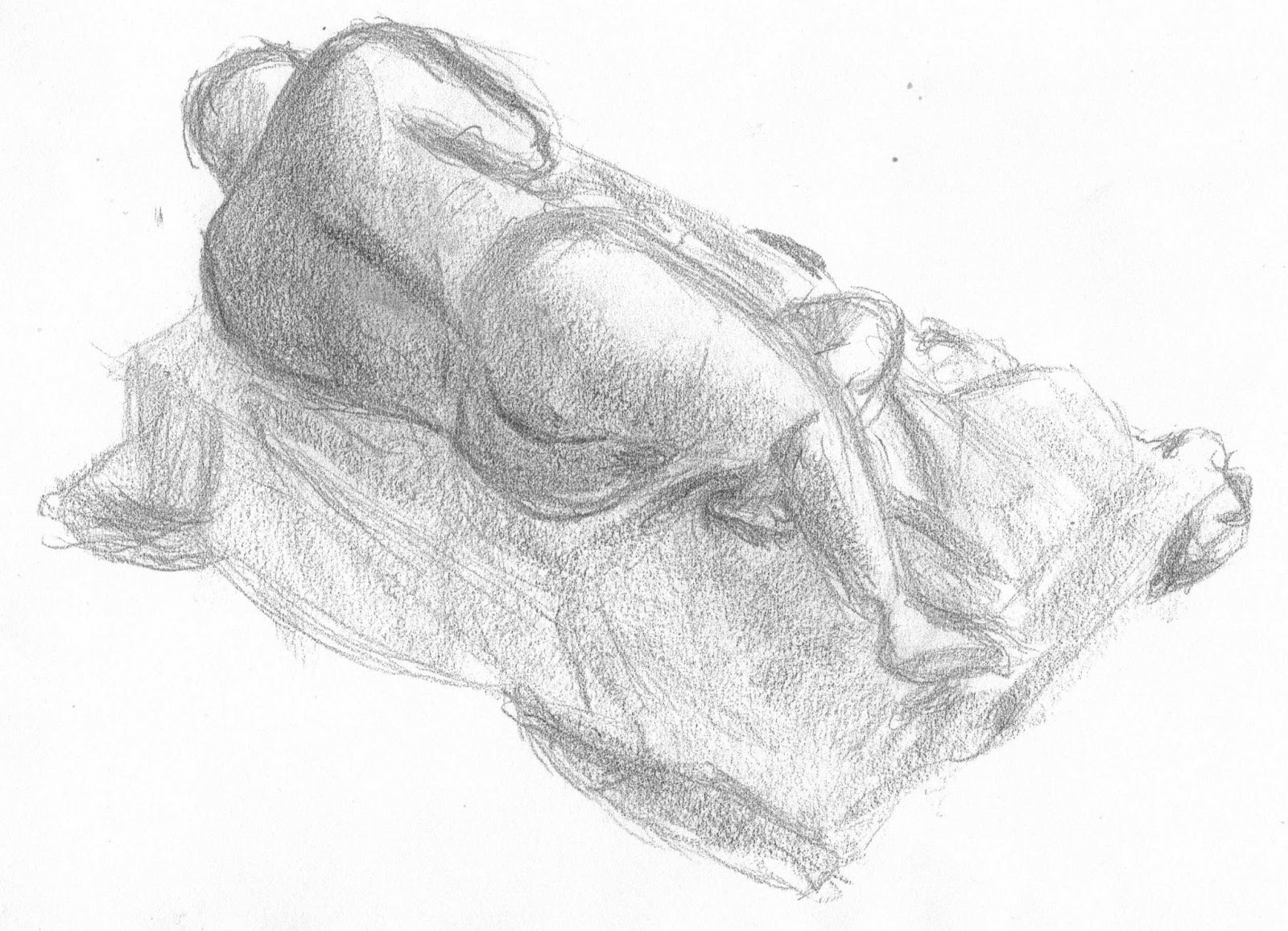
 The focal point of the image would be the part of the cloth which folds into its self at the bottom of the cloth this means that the cloth is in the rule of thirds which makes the drawing more interesting  The same goes for the line of the image which takes the eye around the entire piece of cloth. As the focal point is in the rule of thirds the cloth is not centralized. The hard & soft lines in this drawing brings out the shadows on the edges of the drapery which  shows the where the light was coming from.

None of the shadows are pure black this is because the second any light goes onto a pure black surface it is no longer considered black. There is also foreshortening  on the right part of the top line shows that it is closer to the eye. The shadows in the middle shows that it folds over to the other side. The contrast between the light and shadow is good because it is clear where the light is focused although the drawing is unfinished. There is also a good balance of light and shadow which goes down the middle of the cloth.We can also see all the folds of the cloth because of the form shadows which add depth to the cloth. If there were cast shadows of the cloth that would add another level of depth because the cast shadow will help show the direction of the light hitting the cloth.

Saturday, 2 February 2013

Still Life: Form & Shape


The shading brings out the shape of the objects and also would show the composition better if there was more of it. The concave on the force feeder works with the foreshortening of the front of the object to show where it is facing with the other objects. The main focal point of this drawing is the large jug as that is the first thing the eye sees because of the size of the object and the shading.The first area of interest would be the flowers because of the conclaves used for the petals. The second area of interest would be the bottle as it is the darkest object in the drawing so the eye would be interested with it

The drawing can be followed with the lines of the objects starting from the the top of the large vase it then follows the line down to the rim of the small jug along  two the flowers, along the vase, to the small jugs handle, up slightly up the large vase, to the object behind it to the bottle then the rock and the force feeder.However because there is no folds or shading the empty space between the rock and the large jug breaks the flow of the image. The drawing has a ok balance of light and darkness which goes diagonally from top left to bottom right, because of this the direction of the light is shown making the composition look more three dimensional.